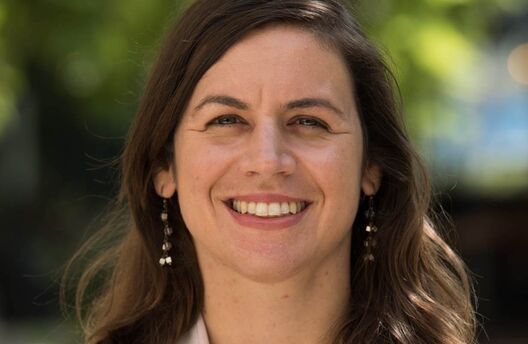
Claire McEvoy, PhD, RD, on the Mediterranean Diet and the Link Between Nutrition and Brain Health
Lecturer, Nutrition and Ageing Research, Institute for Global Food Security, Centre for Public Health, Queen's University, Belfast, Northern Ireland
As a 2015 Paul B. Beeson Emerging Leaders Career Development Award in Aging scholar, Claire McEvoy, PhD, RD, has focused her fellowship research on the Mediterranean diet and other healthy eating patterns. Her goal is “to increase our knowledge on how diet contributes to cognitive health during aging, and also to understand how best we can support dietary behavior change at different life stages to improve health and well-being.”
“Ultimately, my goal is to identify effective dietary strategies to prevent and treat cognitive disorders during aging,” says McEvoy, whose Beeson fellowship included a year working with 2001 Beeson Scholar Kristine Yaffe, M.D., in her prestigious lab at the University of California, San Francisco.
Before earning her PhD in Public Health Nutrition from Queen’s University Belfast in 2012 and embarking on a research career there, McEvoy spent a decade working in clinical nutrition for the National Health Service in Northern Ireland. That experience “supporting people to make appropriate and evidence-based dietary choices has completely influenced the type of research I do—testing dietary patterns on age-related health outcomes under real-life conditions that can be more easily translated for public health benefit,” she says.
We recently talked with McEvoy about the link between nutrition and cognitive decline, and the implications of her research for dementia, Alzheimer’s disease, and healthy aging.
What should people understand about the link between diet and brain health, especially as it relates to the Mediterranean diet and healthy aging?
It’s generally believed that what’s good for the heart is good for the brain, and that is why most research into diet and brain health to date has focused on the traditional Mediterranean diet. The Mediterranean diet is proven to be effective for reducing both primary and secondary cardiovascular disease and has also shown clinically significant benefits for several cardiovascular disease risk factors—such as cholesterol profiles, high blood pressure, fasting glucose level, and inflammatory biomarkers—which are also risk factors for cognitive decline.
The traditional Mediterranean diet is a plant-based diet rich in fruit and vegetables, whole grains, legumes, and moderate in fish and nuts, as well as alcohol that tends to be consumed at mealtimes. It’s also generally low in processed foods, sugary foods, and red meat.
Observational evidence, while inconsistent, tends to support the Mediterranean diet for brain health as well as cardiovascular health. However, the effects of Mediterranean diet-associated changes on cognitive function have been tested in few intervention studies. Preliminary results have shown improvement in global cognitive function in response to adopting a Mediterranean diet in people who are at high risk of developing cardiovascular disease.
Some research has focused on single nutrients, like vitamin E or B vitamins. Very often, however, the evidence is mixed, likely because of differences in the types of populations studied and the diverse nature of supplements tested. Some people with poor nutrient status or deficiencies may experience cognitive benefit from supplementation. However, most people in the general population will derive greater health benefits from improving the quality of their usual dietary pattern rather than relying on vitamin supplements.
In two recent studies, you’ve looked at how different types of dietary patterns, including the Mediterranean diet, affect cognitive function in older adults and people in midlife. What are the most important takeaways for people so far?
We investigated the Mediterranean diet in the well-known Health and Retirement Study and Coronary Artery Risk Development In Young Adults (CARDIA) populations and found that greater adherence to the Mediterranean diet was associated with better cognitive health in both older and younger adults.
In the most recent study conducted with Dr. Kristine Yaffe and other CARDIA investigators, the most important take-home message is that maintaining healthy dietary practices that align with the Mediterranean diet during young adulthood can help to preserve cognitive function even at middle age. This is an important point. Because diet is likely to provide subtle, but cumulative, protective effects on brain health across the life course that help to reduce the risk of, or at least slow down, cognitive decline as we get older, and potentially help to delay dementia in late life.
What are some of the key points research is revealing about the science behind the health benefits of the Mediterranean diet?
In our dietary analyses, we’ve found that individual food components on their own tend to have weaker associations with health outcomes compared with the overall dietary pattern. Therefore, while single foods and nutrients may be important, the combination of foods and nutrients within the dietary pattern can act synergistically to have greater biological effects in the human body. Examining dietary patterns in relation to health outcomes is an important area of aging research.
In addition, we’re beginning to understand more about the mechanisms of how healthy dietary patterns, such as the Mediterranean diet, affect brain health. These insights come from a range of studies in both animals and humans. As mentioned earlier, one way in which the Mediterranean diet may have a beneficial impact on cognitive health is because it improves our vascular health.
The Mediterranean diet and other high-quality dietary patterns also have anti-oxidant and anti-inflammatory effects that are plausible biological pathways to protect against cognitive decline and dementia. And data from emerging research suggests that the Mediterranean diet contributes to neuronal integrity across the life course. Observational studies have reported a link between Mediterranean diet and more favorable brain structures and functions that protect against cognitive decline during aging. Greater adherence to the Mediterranean diet has been associated with lower rates of brain volume loss or brain atrophy, better structural connectivity and less amyloid beta accumulation as we age. These findings from imaging studies are exciting and can help us understand the mechanisms of how healthy dietary patterns contribute to brain health. However, we need adequately powered intervention studies to better examine the effect of dietary modification on clinically relevant cognitive and neuroimaging outcomes.
Your current research would seem to have larger implications regarding nutrition and healthy aging. Where do you think this might lead?
I am very much a public health researcher, so I want to help inform dietary recommendations that will benefit brain health across the life course to prevent or delay Alzheimer’s disease and dementia in later life. The Mediterranean diet is clearly an important dietary pattern for overall healthy aging. But it should be emphasized that we don’t yet know the optimal combination of foods and nutrients for brain health.
One of the most interesting aspects of diet is that it has the potential to influence the pathogenesis of several diseases, including obesity, diabetes, cardiovascular disease, and some types of cancer. Addressing poor-quality diets and diet-related disease in our population should be a major policy focus for healthy aging. While it is important to generate a robust evidence base of “what works,” a key challenge going forward is finding effective ways to support dietary behavior change to promote healthy aging and disease prevention.
This article also appears on NextAvenue.org as part of an editorial partnership between AFAR and Next Avenue, public media’s first and only national journalism service for America’s booming 50+ population, delivering vital ideas, context and perspectives on issues that matter most as we age.
Ask the Expert: Mehmood Khan, MD, on Technologies, Bottlenecks, and Possibilities in Aging Research
March 23, 2026
AFAR is pleased to share Part II of our Ask the Expert interview series featuring Mehmood Khan, MD, Chief Executive Officer of the HevolutionFoundation.
Ask the Expert: Mehmood Khan, MD, on Hevolution Foundation’s Inspiration and Vision for Healthy Aging
February 24, 2026
AFAR is pleased to share Part I of our Ask the Expert interview series featuring Mehmood Khan, MD, Chief Executive Officer of the HevolutionFoundation.
Ask the Expert: AFAR Scholar-in-Residence Raiany Romanni-Klein, PhD, on the Economics and Bioethics of Healthy Aging
January 27, 2026
AFAR is pleased to share our Ask the Expert interview with our inaugural Scholar-in-Residence Raiany Romanni-Klein, PhD, on the Economics and Bioethics of Healthy Aging.
Ask the Expert: Lauren Hunt, PhD, RN, FNP, on a Multidisciplinary Approach to Health Services Research into Geriatric Palliative Care Needs and her 2025 Terrie Fox Wetle Rising Star Award
November 4, 2025
Dr. Lauren Hunt is a doctorate-trained nurse practitioner whose research has focused on understanding geriatric palliative care needs. Her
Ask the Expert Interview: AFAR Board Member Sara Espinoza, MD, MSc, on Translational Geroscience, Promising Therapeutics, and More
September 8, 2025
AFAR is pleased to share our Ask the Expert interview with board member Sara Espinoza, MD, MSc, Director of the Center for Translational Geroscience at Cedars-Sinai.