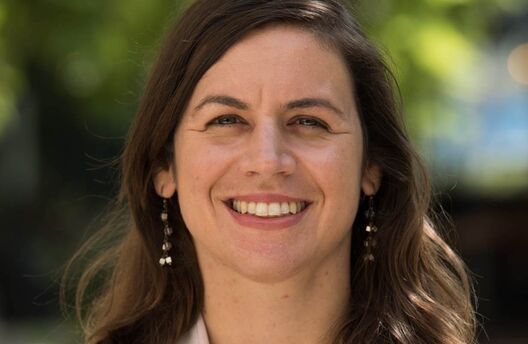
Ask the Expert: Megan Huisingh-Scheetz, MD, MPH, on advancing aging science with technology and her 2024 Terrie Fox Wetle Rising Star Award
Associate Professor, Associate Director of the Aging Research Program, and Co-Director of the Successful Aging and Frailty Evaluation Clinic in the Section of Geriatrics and Palliative Medicine at the University of Chicago
2024 AFAR Terrie Fox Wetle Rising Star Award in Health Services and Aging Research
An epidemiologist and geriatrician, Dr. Huisingh-Scheetz is helping advance research on frailty and interventions to help frail people by using innovative technologies to engage both patients and caregivers, particularly in underserved communities. She’s using accelerometers, or wearable body motion sensors, to study what a person’s movements reveal about their frailty and aging biomarkers. She is also testing whether consumer-grade voice-activated virtual assistants programmed to provide exercise programs and socialization support will improve physical and social functioning of frail, homebound and multimorbid older African-Americans.
After announcing her as this year’s Terrie Fox Wetle Rising Star Award in Health Services and Aging Research recipient, AFAR talked with Dr. Huisingh-Scheetz to gain insight into her work. Her answers were edited for brevity and clarity.
How did your interest in geriatrics get started?
Growing up in rural northwestern Illinois farm country, I was very close to my parents and grandparents and had great appreciation for the obstacles they faced and the value they placed on education. One grandmother was among the first women from the area to go to college and taught in the one-room grade school where my dad and his brothers went. A great-grandmother came from Italy to New York, taught herself how to read and write in English and then made money as a translator. One grandfather was only allowed to go to school through eighth grade but learned to be a successful farmer. His mother had her own sewing business in the Depression.
So, from an early age, I wanted to pay tribute to all of them and thought the best way to do that was to make sure they all had a good end of life. I volunteered in high school at our local nursing home. In college I discovered a love of biology that led to medicine and then geriatrics was my obvious choice for a specialty. I have always felt more comfortable around older adults than around my own peers.
And how did you decide to bring a multidisciplinary approach to your career?
Our healthcare system is very evidence-based, and I appreciate that a lot. But I only had a few brief talks in medical school about how to critically analyze the literature and distinguish a good study from a bad one. I wanted to have the skills to critically review the evidence I would use in my practice, which is why I pursued a master's in epidemiology. It was at the same time I was getting my medical degree, and I was also volunteering in a research lab. I realized that research was a powerful tool for making changes in our healthcare system and policy.
Later, in clinic, I kept seeing the same aging problems over and over. And to fix problems one patient at a time wasn't going to make the level of change I felt like I wanted to be doing for my parents and patients. Addressing problems at a scaled level, generating the evidence that we need to make policy change, was the answer for me.
Why did you decide to focus on harnessing technology to help older patients?
The last thought you might imagine from a geriatrician is, “Let’s introduce technology to this group who doesn't traditionally use technology." But I had a gut sense that tech might be part of some answers to problems I was seeing.
One of my goals is to standardize and scale population-level screening for vulnerabilities including frailty, sensory impairment, cognitive impairment and social needs – so that people get routinely evaluated and monitored the same way and we can trigger interventions quickly. But to do that in a clinic takes significant time and relies on patients coming to clinic. It seemed technology could help by facilitating easier, faster and potentially remote evaluations. I started exploring data from accelerometers because clinical measures of function rely heavily on gait, activity, and strength. These wearable sensors are also non-invasive, collect passive data and are becoming broadly available. And I was fortunate to be at U. Chicago, home of the National Institute on Aging’s National Social Life, Health, and Aging Project. Its dataset incorporated accelerometry, so I was able to start studying the relationships between accelerometry and aging outcomes during my NIA K23 in this dataset.
You’re now applying your success with older patients wearing sensors to a new tech-based project. What’s it about?
Of the patients who come to my clinic for a consultation and frailty evaluation, exercise of some kind is almost always in our plan. But to get a frail older adult to exercise every day is nearly impossible, especially when they are homebound, reliant on a care partner, and starting to lose cognitive function. Plus, there is a big shortage of people delivering in-home aging care.
So, I turned to technology again – in this case to deliver strength and balance training on demand to frail older adults in their homes. Potential users have helped design the program, called EngAGE, from its inception. We initially thought it was going to be a phone app or a tablet. We did focus groups and interviews with frail older adults and most of them said, "I can't type anymore. I can barely even see my phone. And my computer sits in the corner under my laundry.” So, we pivoted to the voice activated device, using an Amazon Alexa Show with a 10-inch screen so we could provide both audio and video directions. The point was to make the burden of using the technology as low as possible.
A central part of this project seems to be giving older people, especially from disadvantaged communities, some power over their own care.
Absolutely, and my view is it’s especially important to empower people who have suffered because of the historic inequities in our health system. We are recruiting people to participate in our clinical trial, very much motivated by wanting to help the people who struggle the most be part of research, access healthy aging programming or even to come to clinic. So, we are exclusively recruiting African American people older than 60 from the Chicagoland area who have significant frailty and two or more chronic conditions.
This is a crew that historically has been excluded from most trials, and a disproportionate share are living below or just above the poverty level. The long-term hope is to find or create programs that help them preserve or regain independence, improve their quality of life as they age and – and also elevate their voices and needs through their participation in research.
Have you become convinced tech has singular benefits for extending healthspan?
Technology is just a strategy for addressing the underlying issues older patients are facing. One is we're not detecting vulnerabilities early enough and providing responsive interventions quickly enough. We need a better system for screening and monitoring people in their community. Another is that long-term services and supports are basically not covered by Medicare but are absolutely essential for healthy aging. Our healthcare system remains way too reactive. We cover medications, hospital stays, clinic visits, surgeries and labs but few long-term prevention programs that keep people healthier for longer and have almost no side effects.
If technology turns out to be not the right approach to a scalable way to help frail adults, then by all means we should find something else.
What is especially meaningful to you about winning this award?
Being honored along with Jeremy Walston, your Irving S. Wright Award of Distinction recipient this year. He is the reason my focus is frailty. When I was a junior faculty and looking for mentors to be on my NIA K23 award, I connected with him because the John Hopkins Pepper Center was focused on frailty. Jeremy didn't know me from anyone but just opened his arms for mentorship. And for nearly a decade now, I've been allowed as an outsider to call in twice a month to their frailty working group, which has been a big source of inspiration and feedback.
I call him my North Star. He's a dedicated geriatrician and scientist who’s passionate about aging research ranging from translational to implementation science. He is brave, forges new pathways, and promotes innovative team science but remains humble, professional, generous and caring. They always say it's helpful if you can find someone in your field to be your role model, so you have some vision of the kind of person you want to be someday. He is my target. He has helped so many become better scientists and better humans.