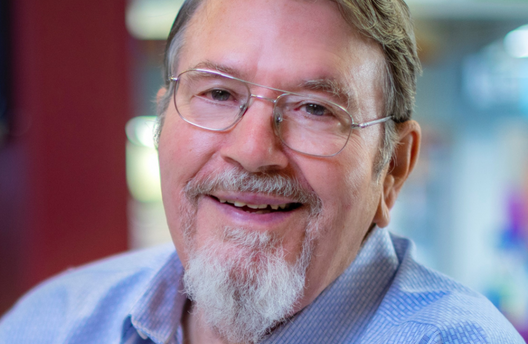
Ask the Expert: David B. Allison, PhD, on Obesity, Nutrition, and the Science of Healthy Aging and his 2025 Irving S. Wright Award of Distinction
Professor, Endowed Chair, and Director of USDA-ARS Children’s Nutrition Research Center, Baylor College of Medicine
2025 Irving S. Wright Award of Distinction
A leader in obesity, nutrition, and aging research, Dr. Allison’s research has been continuously funded by the NIH for over 30 years, and he has authored over 700 publications. He received a Transformative R01 Research Award from the NIH on Energetics, Disparities & Lifespan and is a member of the National Academy of Medicine of the National Academies. He is widely recognized as a leader in research exploring the intersection of caloric restriction, obesity, and lifespan. He is also recognized for his unique contributions to biomedical aging research through mentoring, national methods courses, statistical methods, research rigor, collaboration, and the unwavering promotion of truthfulness and trustworthiness in science.
For his dedication to healthy aging and his numerous contributions to the field of aging research, Dr. Allison received AFAR’s Irving S. Wright Award of Distinction this year. AFAR talked with Dr. Allison to glean insight into his work. His answers were edited for brevity and clarity.
What inspired you to focus on aging research?
From the earliest of ages, I was involved in science in general. It’s in my blood and this is who I am. Even as a child, I asked questions about nature, life sciences, and animals. When adults answered, I would follow up with “How do you know that?” and “Are you sure?” That could be very annoying to adults, and even other scientists can get annoyed when you question their theories or conclusions. However, most scientists think that is what we do, and that is definitely what I do. I’m intellectually very gregarious, and being a biostatistician allows me to expand and learn in any field of science. I go where the trail (or in this case, data) takes me.
I had access to the Longitudinal Study of Aging database early on in my career. In truth, it was because of the availability of data that I began to work on it. The work was fun, but I noticed that the statistical analyses advocated in the field to find connections between obesity and mortality were full of ‘ad hoceries’. This is a quandary that we have been in for decades—using statistics to make meaning of data we have rather than collecting the data we need. I realized what is needed is different evidence. If we keep collecting data in the traditional way, we will never have the evidence to resolve disputes and confirm theories. There is no amount of statistical sophistication that is going to get us confident estimates of cause and effect with the current data. Thus, I have focused on the development of experiments and studies that harness the power of randomization.
One of my first projects worked with rodents, because it is easier to design a controlled trial. I collaborated with Professor Rick Weindruch, who was an expert in caloric restriction and rodent models. We ended up working on multiple projects over the years, and he introduced me to others in the longevity and geroscience field, and that is how I built my reputation in the field.
What is the biggest misconception the public holds about the relationship between obesity and aging, and how do you hope your research can improve this perception?
Obesity is a social construction. There is not a stone tablet somewhere that tells us exactly what obesity is. I think it appropriate to allow for range when using the term. When we say obese, we are really thinking about multiple questions involving how much body fat we have, how much body weight we have relative to our height, what type and quantity of food is consumed, how much physical activity is done, how much skeletal muscle, and so on. There are clinical definitions, diagnosis, and rankings when it comes to obesity. At this point, we do have reasonably good data that allows us to conventionally classify humans as obese or not.
We also have solid data that confirms that caloric restriction through diet, bariatric surgery or modern pharmaceuticals, like the GLP1 agonist related drugs, will extend the healthy lifespan. We could not confidently say that 20 years ago, but we can today. That is a big advance.
In nutrition science, we know eliminating caloric insufficiencies (starvation) and excesses, essential vitamin and mineral deficiencies, protein energy deficiency, and toxins and pathogens will preserve and prolong life. After that, we are less confident that quality of diet in humans influences the length of life. There is some observational epidemiologic evidence, but more data is needed. Likewise, exercise and resistance training are good for you, but we don’t have definitive proof they will make you live longer. Thus, more studies are needed to confirm whether exercise and diet affect longevity.
You’ve led efforts to improve the rigor and reproducibility of research. Why is that particularly important for aging research and geroscience?
Rigor and reproducibility are important everywhere. Some talk about there being a replication or reproducibility crisis, but I do not see evidence of a crisis. That doesn't mean studies with poor reproducibility don’t exist, but we are better able to evaluate and identify those studies as being poorly done. My own sense is that science and rigor keep getting better. That's because the nature of science makes itself better. We're always evaluating.
President Trump's executive order used the term “gold standard science” and many of us love those words, but one thing some of us did not agree with was the idea of “restoring” the gold standard. This implies that at some point we stopped using the highest standards. While we can point to examples of sloppy statistics, interpretive overreach, and design and measurement mistakes, those are not considered quality science. As scientists we work to ensure that truthful information is disseminated, because our reputation, the field’s reputation, tax-payer investments, and even human lives are at stake.
Identifying what the truth is can be particularly tricky because we're not dealing with things that are often easy to see or to evaluate. If we were studying the effects of decapitation on verbal production, the answer would be pretty simple. When you're studying longevity, the answers take time. If we designed a trial to see how GLP1-agonists prolong the life of 20-year-old humans, the research team may be dead before you have the answer. Thus, we are working to identify meaningful shorter-term study designs.
Dr. Wright founded AFAR over forty years ago. What does winning this award mean to you?
It's a tremendous honor. We all do science for different reasons, and I do it because I must. Science drives me, but I love it. I try not to tell my employers this, but if they didn't pay me to do science, I'd pay them for the opportunity. In my career, the gain that is the most gratifying is the respect of one's peers. I engage in research to be beneficent, to try to help people, but mostly I do it because it's intriguing, and I love puzzles and figuring things out. I love the wonder of science, the beauty of science, but to have one's peers say, “We value you, and we value the work you do. Your work has helped us, the field, and people.” It's hard to imagine a gain or honor sweeter than that.
How do you see the role of data science and biostatistics evolving in the field of aging research over the next decade?
In data science, we're trying to figure things out, trying to figure out what's true, what we know—that is epistemology. I believe the role of empirical epistemology will continue to rise over the next decade. The empirical part of data science, what we do with data, will continue to evolve. We have reduced and nearly eliminated our computing limitations. That is, the ability to compute things is not a big deal anymore, and more scientists can analyze data. Unfortunately, that also means lots of unscrupulous people can run lots of models. Even well-intentioned scientists can wittingly or unwittingly misanalyse or cherry-pick data, and that's a big problem. So strong peer-review of data, education in logic, design, and analysis, and, above all, a commitment to the unvarnished truth are our holy grails.