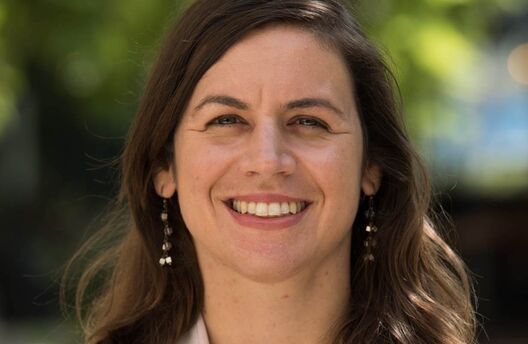
Ask the Expert: Claire Ankuda, MD, MPH, MSc, on how Medicare Advantage shapes care for the seriously ill and her 2023 Terrie Fox Wetle Rising Star Award
A palliative medicine physician and a clinician-investigator, Dr. Ankuda’s research is seeking evidence for changing Medicare policies to pay for more home-based support of older adults with functional disabilities and serious illness, especially Alzheimer’s or related dementias. After announcing her as the Terrie Fox Wetle Rising Star Award in Health Services and Aging Research recipient, AFAR talked with Dr. Ankuda to gain insight into her work. Her answers were edited for brevity and clarity.
What first got you interested in the intersection of policy and the field of aging?
I did my medical training in Vermont, Boston, Seattle, Michigan and New York City, and that range of experience got me interested in how care varied so dramatically from place to place—particularly aging and end-of-life care and the support people received.
Initially I was interested in decision-making about things like whether patients receive further chemotherapy, whether they wish to age in place and other really challenging decisions people make with their families and physicians. What I saw was that people could have amazing conversations clarifying their goals, but those were meaningless if they didn't have the practical support available. I came to appreciate how supports provided by Medicare and Medicaid really influenced what people receive for services but those differed dramatically from place to place, from insurance plan to insurance plan, and from person to person—and that really shaped quality of care at the end of life.
That got me interested in Medicare Advantage, or commercial Medicare, because it now insures just over half of older adults in Medicare and introduces incredible variation to the health insurance people have—and their care and outcomes.
The Wetle Award is for researchers with a multidisciplinary approach. Why has that been important to you?
I have training as a hospice and palliative medicine physician and am board-certified in family medicine. I also have a master's in health services research, did some policy training in the Robert Wood Johnson Clinical Scholars Program Fellowship and was an intern at the Center for Medicare and Medicaid Innovation. All that has helped me bridge medicine and policy. But I collaborate with economists, who know what approaches can best estimate how different plans are shaping care of older adults with serious illness, and health services researchers who help with some complex modeling approaches. Other collaborators help me understand the clinical impacts of Medicare Advantage plans on patients and the complex regulatory issues that explain why those plans operate the way they do.
What is the biggest challenge to your work, the thing that Medicare Advantage most urgently needs to fix?
The lack of transparency. For instance, in the last few years MA plans have been allowed to pay for services not traditionally covered by Medicare, like transportation, meals in the home, direct paid caregiving and caregiver support, things really important to older adults aging in place. We know which plans offer what, but we don't have data on who's being offered the benefits, at what time, and with what level of intensity. That lack of information is an example of why it's really challenging to study the impact of these plans.
We also know MA plans reduce their costs with prior authorization requirements and denials. Those can make receiving care very challenging for older adults seeking expensive things like MRIs or chemotherapy. But we don't have great data on rates of denials and the uses and burdens of prior authorization rules. That makes it tough to study the impact of plans on older adults—and tough for older adults to choose their plans.
We have very clear data about traditional Medicare because its fee-for-service and the government is paying for each service. It's more challenging in Medicare Advantage because the plans are sort of a middleman and are being paid at a per capita rate. In general, the quality of data is highly linked to whether or not there’s a payment for recording it. When payment is not for each service, we just have less information about these services. That said, the Centers for Medicare & Medicaid Services could incentivize or even mandate that MA plans collect and release more data.
And what has been the proudest achievement of your work?
I won't say I've achieved it yet, but we are starting to shed light on the Medicare Advantage experiences of older adults with serious illness. Many of the measurements we have come from Medicare itself and are focused on the healthier population, who of course are using relatively little insurance. So we really have to do more independent measuring of the experiences of the seriously ill.
One study I did looked at the quality of care during the last month of life, as reported by proxies for people who died. We heard that quality was worse in Medicare Advantage plans than in traditional Medicare. That's important for two reasons. We focused on the sickest beneficiaries. And, since it’s difficult to measure quality from claims alone, we listened to older adults and their care partners.
Relying on surveys of people's experience is where research has to go. I am sure some MA plans are doing a wonderful job caring for older adults with serious illness. Others are not. We need better markers of which plans are which, so we can inform both regulations and the public.
In addition to this work, you also did research on the impact of Covid-19 on Medicare policies. What did you learn?
When the pandemic surge hit in 2020, I was a palliative medicine physician at Mount Sinai Hospital. Seeing the tremendous death and burden on older adults in New York City, particularly Hispanic and Black older adults, compelled me to do some research on the impact of Covid on those people.
In some ways it was a side focus of my research. But it also highlighted some cracks in the system, some populations that were—and still are—receiving lower-quality services and fewer services at home. It made me further ask, how is your care affected if you’re in an MA plan with a narrow network that, say, means you can only receive services from one home health agency?
Where do you see your part of aging research going in the next 10 years?
We will have a better understanding of the variation in MA plans and a better understanding of what regulations are needed to ensure high-quality care is closer to uniform. And that will be even more important because the share of older people with serious illness using those plans is projected to increase significantly.
There is other work I’ve become interested in since having a baby on my own and moving to rural Vermont, where I'm from and have more family support. I've been really influenced by seeing the distinct challenges of care and aging in a rural place. Hospitals are closing, nursing homes are closing and there is a big shortage of home health aides. So that's certainly a peek into where I think my research will go in the coming decade.