Ask the Expert: 2024 Cristofalo Awardee Bérénice Benayoun, PhD, on her work from basic aging biology to translation, and from promoting a fish for research to understanding sex differences
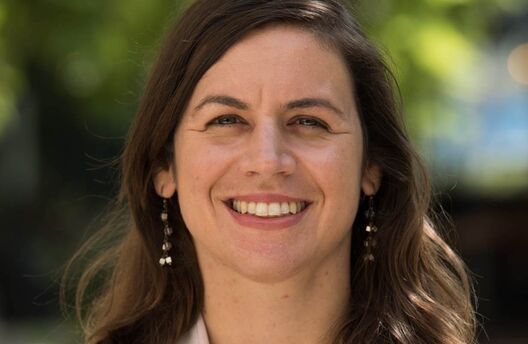
Associate Professor of Gerontology and Biological Sciences, University of Southern California Leonard Davis School of Gerontology
2024 AFAR Vincent Cristofalo Rising Star Award in Aging Research
Dr. Benayoun’s research focuses on biological sex differences in aging. Supported by an AFAR grant in 2020, she developed a toolkit to help others researching the biology of aging conduct studies using the African turquoise killifish, the shortest-lived vertebrate that can be bred in the lab, instead of mice. Her own experiments using the fish have resulted in important findings, with potential therapeutic applications, about how males and females differently experience both neuroinflammation and reproductive organ decline as they age.
Upon receiving the 2024 Vincent Cristofalo Rising Star Award in Aging Research, AFAR talked with Dr. Benayoun to glean insight into her work. Her answers were edited for brevity and clarity.
What got you interested in aging research?
My mom always says I’ve been obsessed with aging biology because she had me when she was 39, and it’s true that ever since I was a girl I have wondered if that could have an impact on me.
But really the start was sort of random. I asked my biology professor in France to help me find a summer research job in the U.S. I didn't know anything about aging, and my work in the lab he found for me ended up learning something about FoxOs, one of the master regulators of longevity. And my mind was completely blown because at that point I had no idea that aging was anything but just decay. And especially with my parents being on the older side of things, this idea was enchanting, that maybe I could do something about it by researching and understanding aging. And so, now this has been my work for 20 years.
And along the way, you decided biologists studying human aging should embrace the African turquoise killifish as a study subject?
The mouse lives two to three years. If you're thinking of a pet, that's way too short. But if you're thinking of an aging research animal, that's way too long—because if you want to see if you're making a difference in their aging, you need to wait these years to know. And if you think of how long a grant lasts, and how long students stay in a lab, three years is a long time.
Since I was a postdoc, I’ve been developing this killifish as a model. C elegans are cheaper than anything to work with, but the worm doesn't have an immune system similar to ours and it doesn't have bones. With the fish, which is actually much cheaper to work with than the mouse, you have a sort of invertebrate-like lifespan with vertebrate-like biology – sort of the best of both worlds.
The killifish has four to six months of lifespan, so we can really see if what we're doing has an impact on aging in a short time. I was the first to assemble and annotate the genome of the fish, back in 2015. Then, using my Glenn-AFAR Grant for Junior Faculty, we mapped out its cell types in the liver, blood, kidney, and spleen—tissues chosen because they're really important for health and have huge functional decline with age. If you want to start potentially designing treatments, you need to understand what's wrong specifically at the cellular level.
Hundreds of labs across the globe are using mice and humans and C elegans. I would say at most a dozen labs worldwide were working on the fish when I started. It might be increasing now because we're making available to others our toolkit for cell type identification and targeted gene expression modulation.
And how have you used the killifish to further your own work?
It looks like this fish has sex differences in aging, just like we do. And so it’s another model we can leverage, especially if we want to do potential interventions.
We’ve looked at the four tissues in male and female young adult killifish and found a huge difference in lipid metabolism. The males have fatty liver, whereas the females do not. And that's interesting because we know human men are more at risk for fatty liver. And obviously, metabolic dysfunction happens with age. So this could be a great model to study that.
We are already starting to test potential pro-longevity interventions. I don’t want to say what the specific drug is, but it's very clear it has metabolic effects. It might be tricking their bodies into thinking they're eating less, which is ameliorating their metabolism, and that is ameliorating their lifespan. It's still early days, but the pilot data shows a 30 percent increase in lifespan, which is enormous for vertebrates.
We’re also looking at neuroinflammation with age. We’re looking at them past sexual maturity and seeing really cool things happening with the microglia, an immune cell of the brain, in terms of the inflammation as a function of sex and strain and age.
Finally, reproductive aging, which has been very long dismissed as just a matter of fertility, so no one in science has cared much. We've looked at reproduction capacity and, sure enough, killifish females lose their ability to reproduce sooner than the males. It's not menopause, but there's something there as well. And so we've done some profiling of the gonads, the testes, and ovaries, to look at what was different in the way those were aging. And we found a huge difference in the activity of a type of genetic element called transposons, a clear pattern in females just giving up on controlling those in the gonads with aging. Obviously, we need to find out if this is happening in humans to see any direct clinical relevance, but it’s a potential therapeutic target people haven't been looking at.
What’s the biggest change coming to aging biology in the next decade, and the biggest challenge?
Following this idea of personalized medicine, I think in 10 years' time we can have precision geroscience, or personalized geroscience, where we can take into account the biology of the individuals we're trying to help.
The one big problem for getting there is that 90 percent of what we know about aging is about males. We've biased everything to the study of male biology and male aging as early as the preclinical steps. That’s because there’s this idea that, "Hormones make the data noisy, and females are just males with hormones." I've heard real scientists say this. And it wasn't until the 1990s that the FDA allowed women to be part of clinical trials, because of this ridiculous idea that women were presumed to be getting pregnant and there’d be potential issues on the pregnancy.
Even now, the overwhelming majority of phase one and two clinical trials recruit only men. That is a big problem for a lot of reasons, including the fact that drug metabolism is super different in females, because of the huge sex dimorphism of the liver, which is where most drugs are processed. So why do women have more than two-thirds of severe side effects reported once drugs hit the market? Because the dosing and safety studies are done in men. This is a problem for aging research as well. Take the NIA’s Intervention Testing Program, which sees if FDA-approved drugs for humans impact aging in mice. You will not be surprised that seven of the eight drugs that they found have an impact on aging work only in mouse males.
The biggest thing we can do over the next 10 years is to start including sex diversity in the preclinical and clinical space, so we can actually make an impact on the health of both men and women. We can also take into account genetic diversity because we know aging profiles and disease profiles of different ethnic groups are different. Based on all the data we have, I am pretty sure that if we included more diverse people in Phase One and Two trials, a lot of times we would realize, "Oh, that drug's only going to work in women," or, "That drug is only going to work better in that ethnic population.”
And what does the next decade look like for you?
Figuring out targets and drugs that will be important for female aging. If we understand how female and male aging differ, we can start designing drugs that are going to work for males and females—and also consider the impact of menopause. It’s the biggest risk factor for every chronic disease and yet, again, there's no requirement to take menopause into account when doing clinical trials. And we know that's going to impact drug metabolism as well.